"The sea is vast, so big..." The skills and wisdom (= folk tools) nurtured through the long relationship between the sea and people, for obtaining its bounty, and the hopes (= toys) that people have held for a bountiful catch towards the sea.Musashino Art University Museum & Library, Folklore Materials RoomExcavated from the approximately 90,000 folk artifacts held by the institution. Separate exhibition rooms are provided for folk tools and toys, and a series of articles, with commentary by Professor Koji Kato of the university, explores the deep connection between people and the sea that has continued from ancient times to the present.Click here for project details.). For the fourth installment, we will introduce sea-themed toys with the theme of "Ebisu the god."
Ebisu, a deity of nature worship unique to Japan.
Among the Seven Lucky Gods, Ebisu (whose name can be written in various ways such as 恵比寿, 恵比須, 戎, and 蛭子, so we will use Ebisu here) is the only one whose origin lies in a deity unique to Japan.Daikokuten、Bishamonten、Benzaiten、Hotei、Fukurokuju、JurojinThe gods were brought to Japan from India and China and became established in popular culture. On the other hand, Ebisu was a transcendent being who brought good fortune from across the sea. There are customs throughout the country of calling whales that suddenly wash ashore Ebisu and giving thanks for the blessings, or burying drowned bodies whose origin is unknown as Ebisu and considering it a sign of a bountiful catch, and these customs show a part of the indigenous belief in the sea.
In Japanese mythology, he appears as a god fishing during the scene of the transfer of the land.Kotoshironushi-no-MikotoFurthermore, the belief in Ebisu, who worships Hiruko, the first god born to Izanagi and Izanami but who was cast adrift at sea, is said to have contributed to the formation of the image of Ebisu as a god who conveys the will of the gods and brings good fortune.
Ebisu Iconographyー
In various parts of Kyushu, there are examples of roadside Ebisu shrines where a pair of male and female deities are enshrined, which is thought to be one of the earlier forms of Ebisu than the typical image we see today. The image of Ebisu that later became established has a typical motif that is immediately recognizable: a benevolent Ebisu face with a beard,Kazeori EboshiにHunting robe・thimbleThe image of Ebisu, seated in traditional Japanese attire and holding a sea bream and fishing rod, is instantly recognizable despite various variations, and can be seen as an example of iconography where the image is linked to its meaning.
*Iconography is the study of the meaning and origin of motifs.
Ebisu and Daikoku, a famous duo
Ebisu and Daikoku have been depicted and worshipped together as a pair of gods of business prosperity among the Seven Lucky Gods. Ebisu is thought to symbolize the blessings of the sea, and Daikoku the blessings of the land, thus representing all kinds of wealth. In mythology, Ebisu is identified with Daikoku.Kotoshironushi-no-MikotoIt is identified as Daikoku.ŌkuninushiSince Ebisu is the child of Daikoku, Ebisu and Daikoku are parent and child.
Manjusri/Fugen BodhisattvaHe is a mad monk who is considered an incarnation of [something].Kanzan JitokuJapanese culture has many pairings, such as the monstrous god Tenaga Ashinaga, but Ebisu and Daikoku are perhaps the most beloved and popular duo among ordinary people.
Toka Ebisu
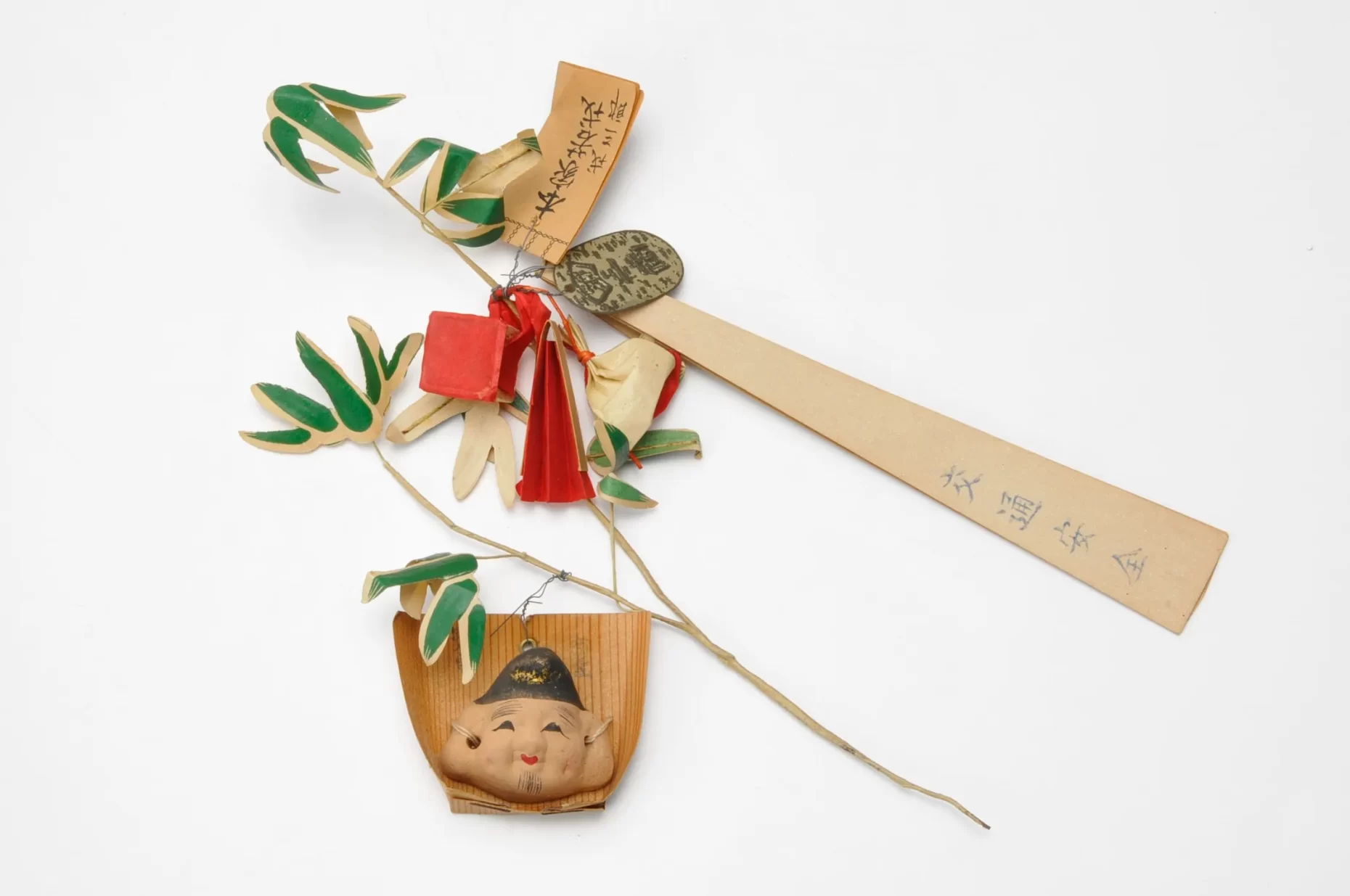
The most grand festival dedicated to the god Ebisu is,Toka EbisuIn the Kansai region in particular, people visit Ebisu shrines on this day and take home a lucky bamboo branch adorned with various auspicious ornaments. It is believed that by returning the old bamboo branch and replacing it with a new one, the power of Ebisu to bestow blessings is renewed, and the old bamboo branch is burned during New Year's events such as Tondo. In Japanese nature worship, the periodic provision of blessings is a very important element, and the lucky bamboo branch can be said to be something that makes this a reality.
Toy Gallery
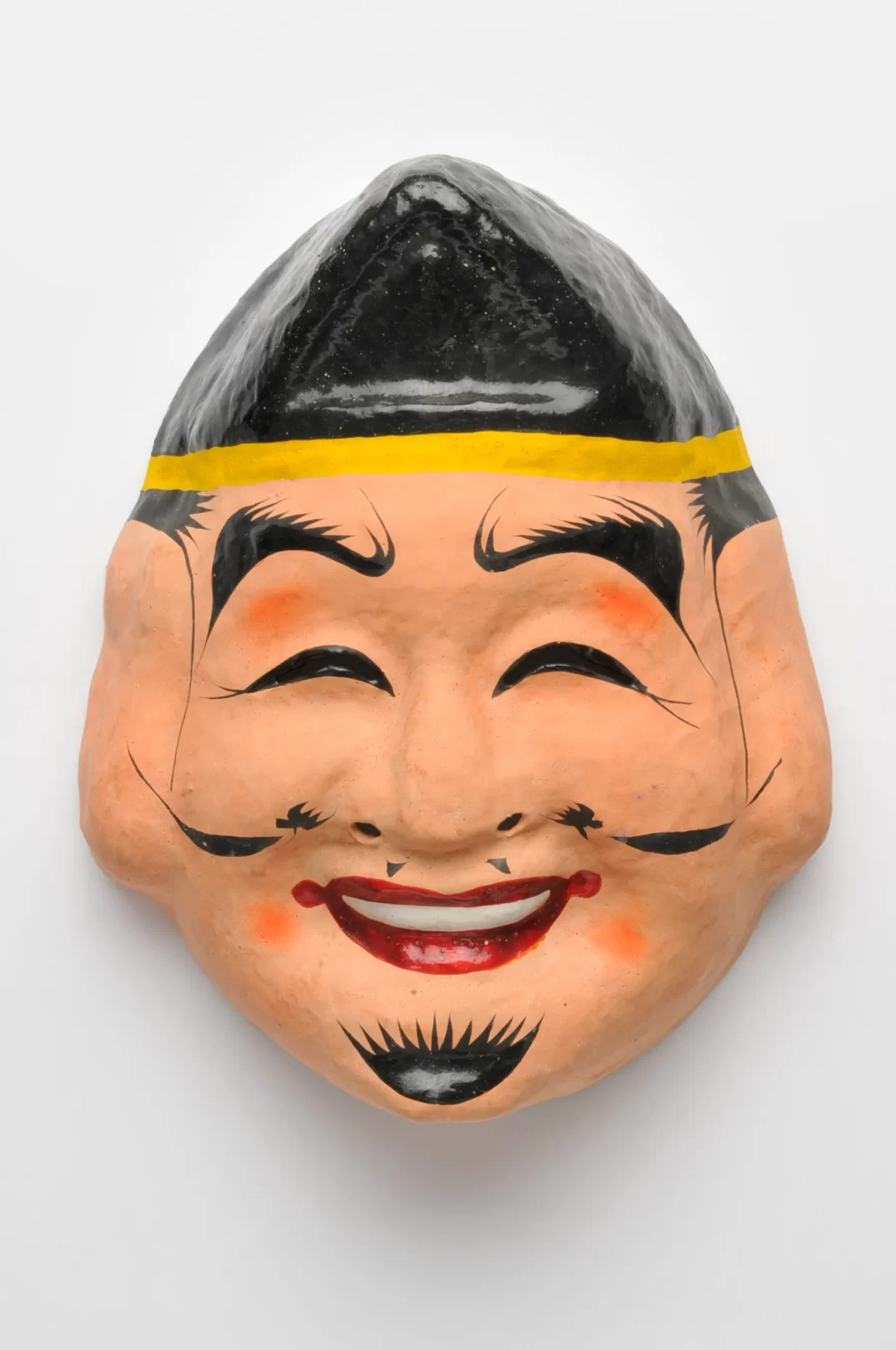
Ebisu face
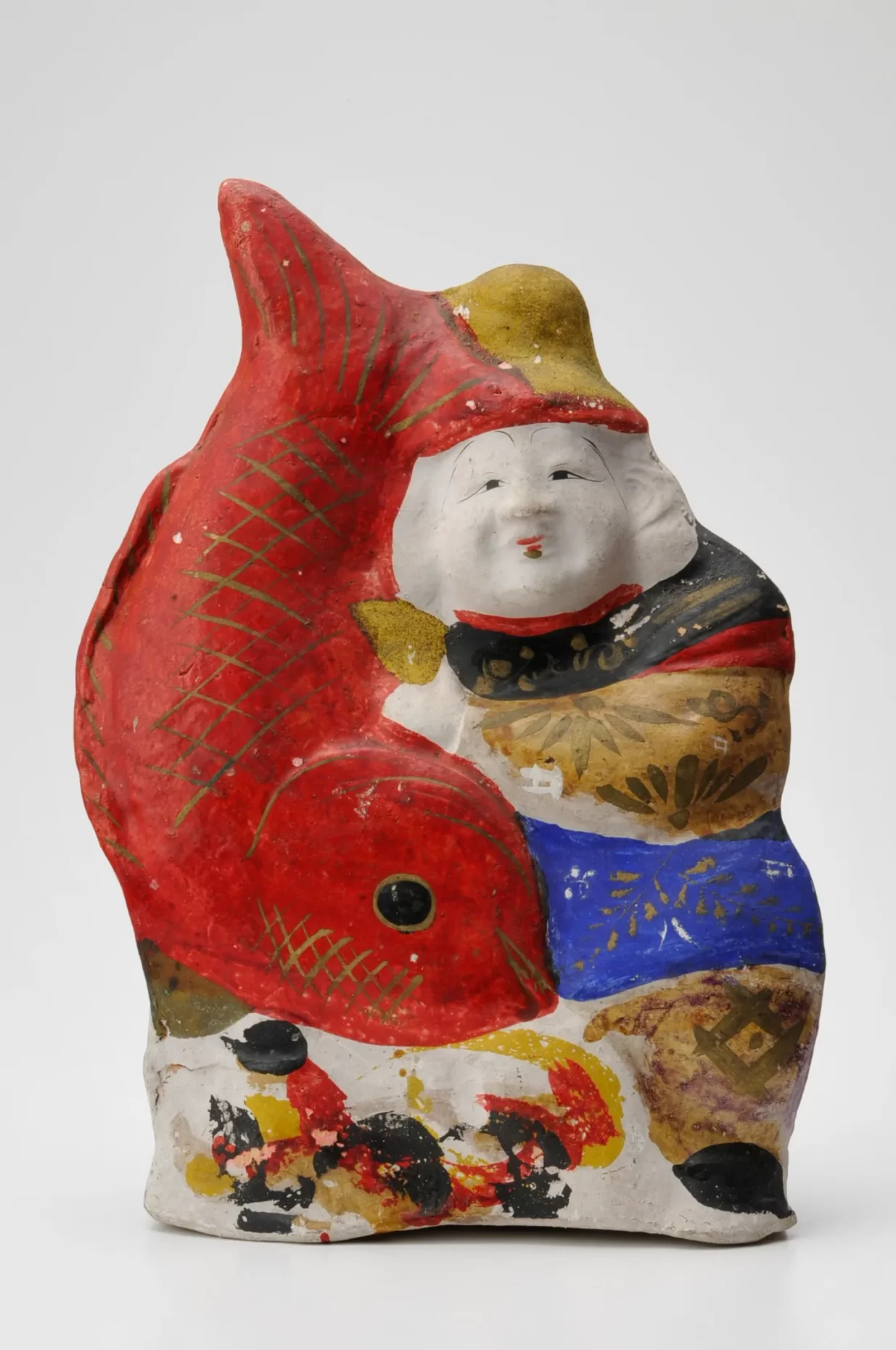
Ebisu's euphoric image comes from his beaming smile, which is known as the "Ebisu face." His well-groomed beard, thick eyebrows, prominent earlobes, and rosy lips with upturned corners spread happiness to people. Ebisu's eyes are never clearly depicted; he simply smiles broadly.
Eboshi or Kineboshi?
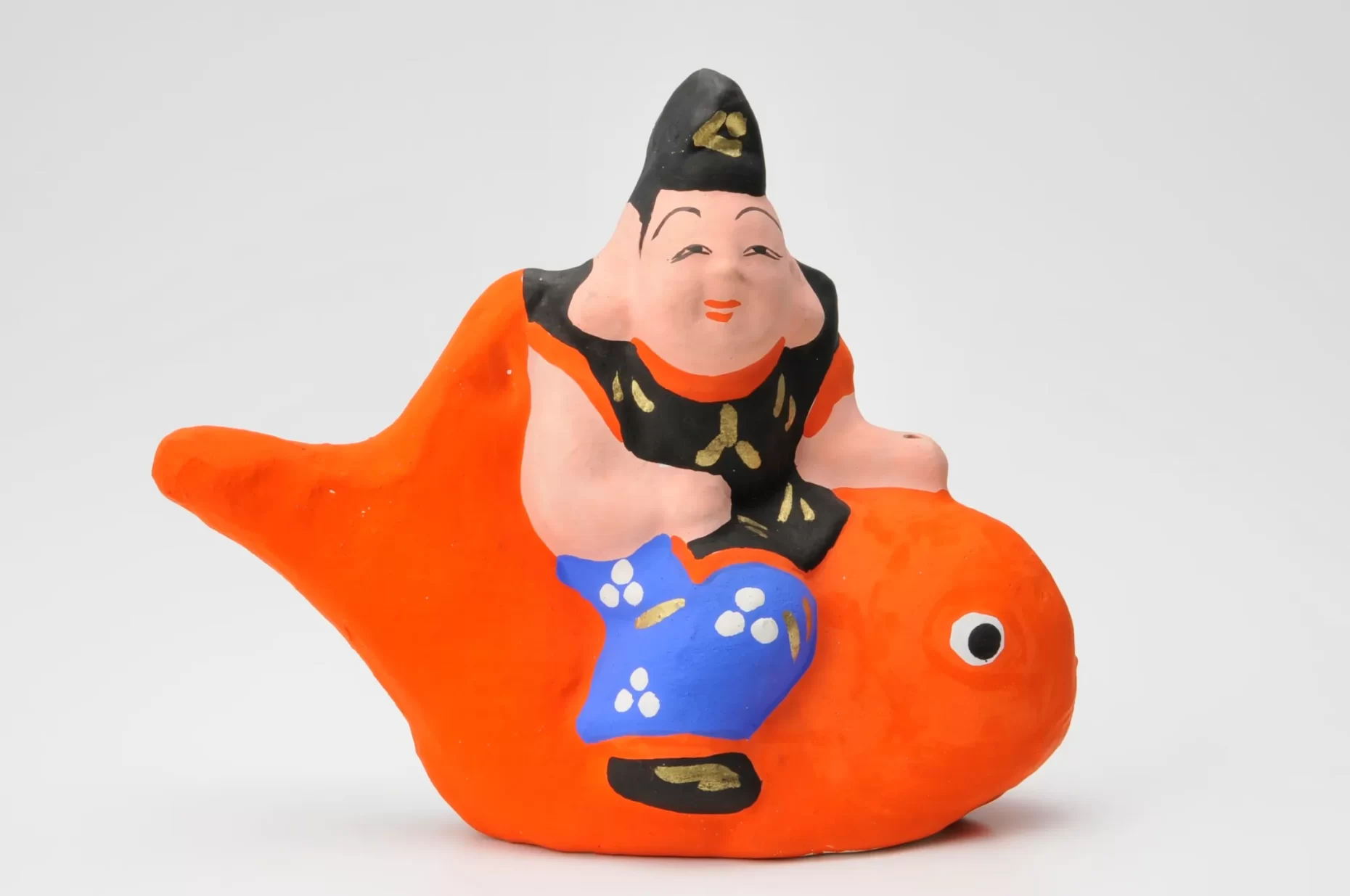
Ebisu isEboshi (a type of hat)They wear these hats. There are two types of eboshi hats: a regular black eboshi and a dazzling gold eboshi. Currently, at the Toka Ebisu festival held at Ebisu shrines throughout the Kansai region, the Fukumusume who distribute lucky bamboo branches wear these hats during the Shinto ritual.Shrine maidenwhite coat andScarlet hakamaWear it overChihayaThis is seen in the standard attire, which includes a golden eboshi hat.
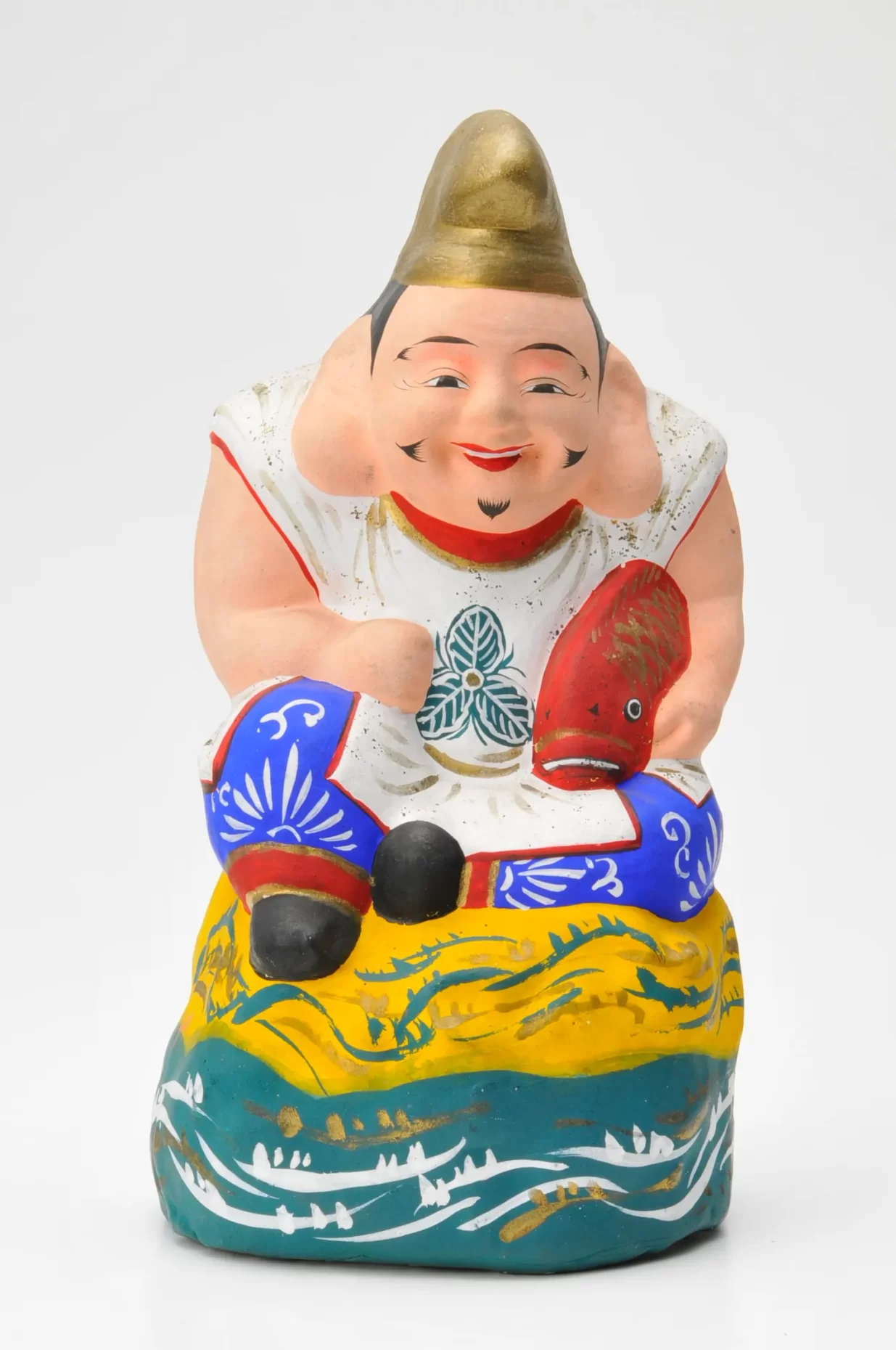
A gigantic lucky sea bream that is too big to hold
The giant sea bream that Ebisu catches from the ocean is a lucky sea bream, symbolizing how great and abundant good fortune and happiness can be, and is depicted as being an impossibly large size. In clay and papier-mâché figurines, it is exaggerated to such an extent that it is depicted as if Ebisu is holding the sea bream in his arms, or riding on it, or even riding on it.
Praying for business prosperity with a lucky bamboo branch
At the Toka Ebisu festival market, lucky bamboo branches adorned with auspicious hanging items and winnowing baskets (which are believed to gather good fortune) with giant Ebisu masks hanging from them are sold.FukumiPeople buy these and pray for business prosperity throughout the year. Nowadays, they are sold with everything already attached, but in the past, it seems that people often chose their own decorations to hang on the bamboo branches.
Planning, supervision, and writing
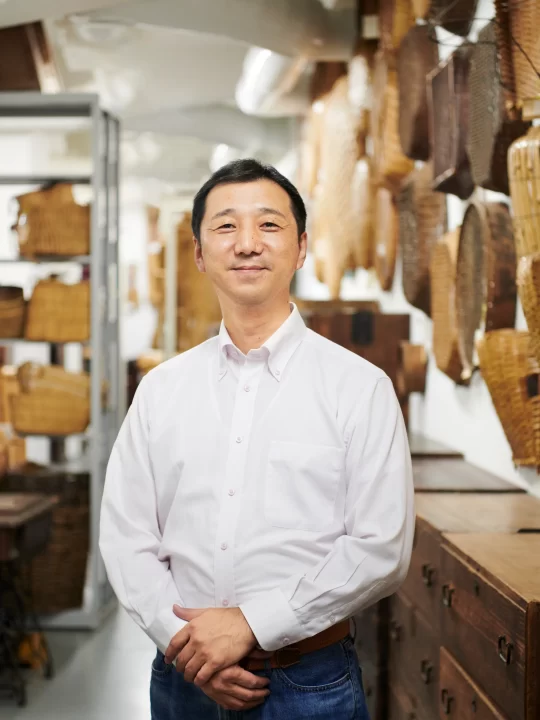
Koji Kato
Professor at Musashino Art University, specializing in folklore (research on folk implements). Holds a PhD in Literature. Previously served as a curator at the Wakayama Prefectural Kii Fudoki-no-Oka Museum and a professor at Tohoku Gakuin University (concurrently serving as a curator at the university museum), before assuming his current position in 2019. His major publications include "Folklore: Facing and Expressing the Past" (Musashino Art Publishing Bureau/2022) and "Folklore: Public Studies: Learning and Practicing for Oneself" (Musashino Art Publishing Bureau/2025).
Exhibition Announcement
An exhibition supervised by Professor Koji Kato, who is overseeing this project, will be held from Monday, June 15th. During the exhibition period, in addition to lectures and talk sessions, there will also be a children's event day called "Minmin Fest!" where you can enjoy various activities related to folk crafts. Please come and visit.
What is this folk implement? — A collection of folk implements left behind by folklorist Tsuneichi Miyamoto at an art university.
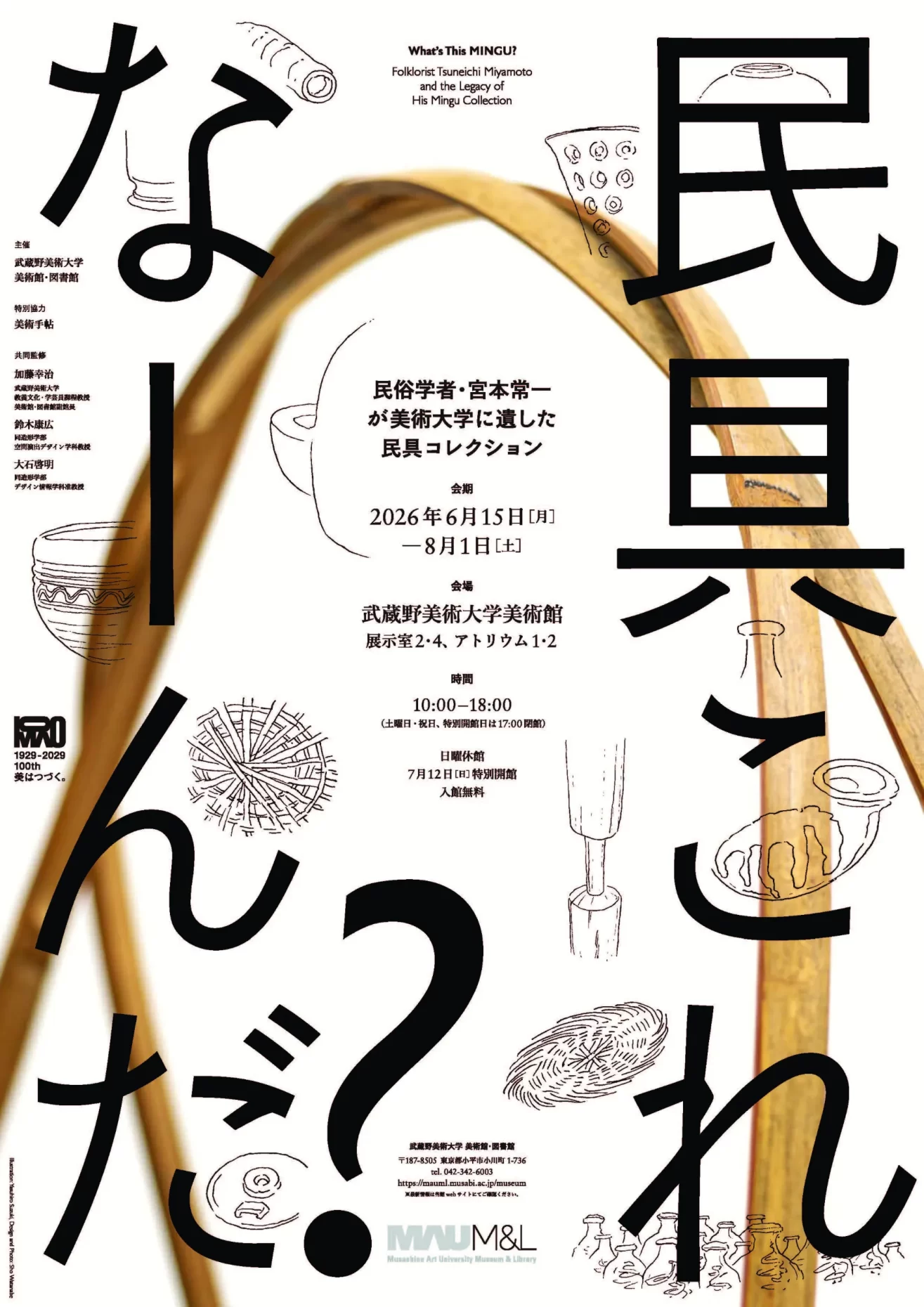
Dates |Monday, June 15, 2026 - Saturday, August 1, 2026
Time|10:00 - 18:00
(Saturdays and public holidays: 10:00-17:00)
Closed days |Sunday
Admission fee |free
Venue |Musashino Art University Museum: Exhibition Rooms 2 & 4, Atrium 1 & 2
Organizer |Musashino Art University Museum & Library
Cooperation |Art Notebook
Supervised by |Koji Kato (Professor, Liberal Arts and Culture, and Curator Training Program, Musashino Art University; Deputy Director, Museum and Library), Yasuhiro Suzuki (Professor, Department of Spatial Design, Faculty of Art and Design, Musashino Art University), Hiroaki Oishi (Associate Professor, Department of Design Information, Faculty of Art and Design, Musashino Art University)
Folk implements, created and used out of the necessities of daily life, are "forms of living." The forms of folk implements reflect the tangible experience of daily life, the skillful use of natural materials, and the imagination that gives shape to the invisible, offering modern people a sense of surprise and discovery akin to encountering a different culture.
The Musashino Art University Museum & Library houses a collection of approximately 90,000 folk artifacts, making it one of the world's largest archives of lifestyle and cultural artifacts held by an art university. This exhibition, based on the verification and reorganization work on the collection's formation that has been underway since 2020, unravels the learning and activities of folklorist Tsuneichi Miyamoto (Professor Emeritus of the University) and the students at the time, which were outside the curriculum.
Furthermore, based on various experiments in the application of art education in the modern era, we will collaborate with the web version of "Bijutsu Techo" (Art Notebook) to create an exhibition from an art and design perspective. Enjoy a new exhibition experience with participatory exhibits based on observation and interpretation, an unexpected curation of folk implements with diverse backgrounds, and reinterpretations of folk implements through digital technology and spatial expression.