"The Meaning of the Sea" Vol.5
Tomoko Konishi (Navigator, Captain, Nippon Yusen Kabushiki Kaisha)
Work do while traveling
A longing for the word "captain." A metaphor of "ship" and "voyage," used to describe a group of people belonging to the same group or heading in the same direction. Since the time of "Wu and Yue in the same boat" in ancient China, we have held a special gaze towards people who cross the seas and the ships in which they operate. But what is the reality of the world beyond our gaze?
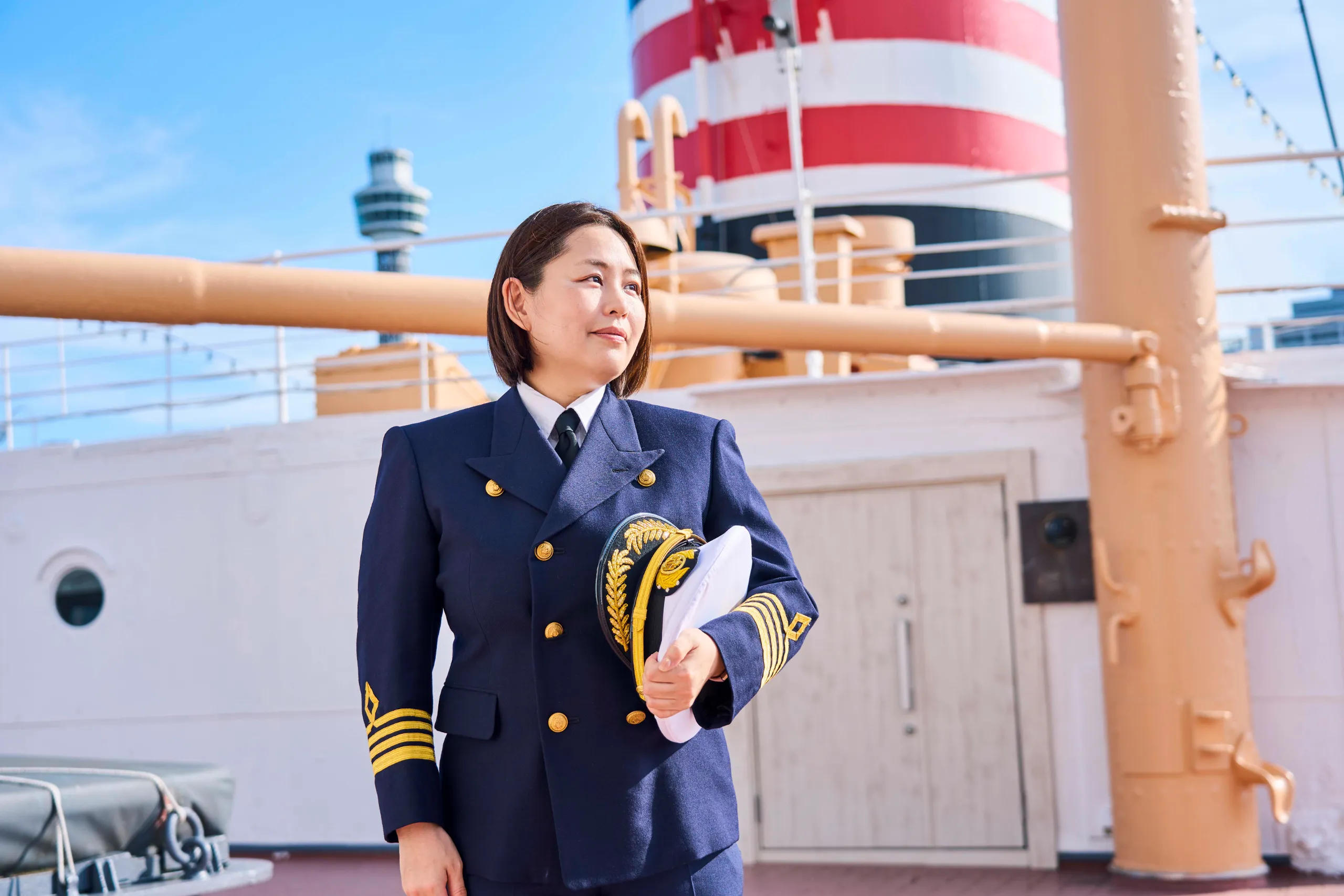
After joining Nippon Yusen Kabushiki Kaisha (NYK Line), Tomoko Konishi worked as a navigator on ocean-going cargo ships that sailed across national borders, playing a vital role in connecting logistics between Japan and the world. Since 2017, she has assumed the important responsibility of being the company's first female captain.
"There are certainly days that are designated as 'Rest Days on board.' But while we're at sea, the ship continues to move, so once we set sail, there's no day when I can forget about work. I make the most of the time I'm on land to refresh myself."
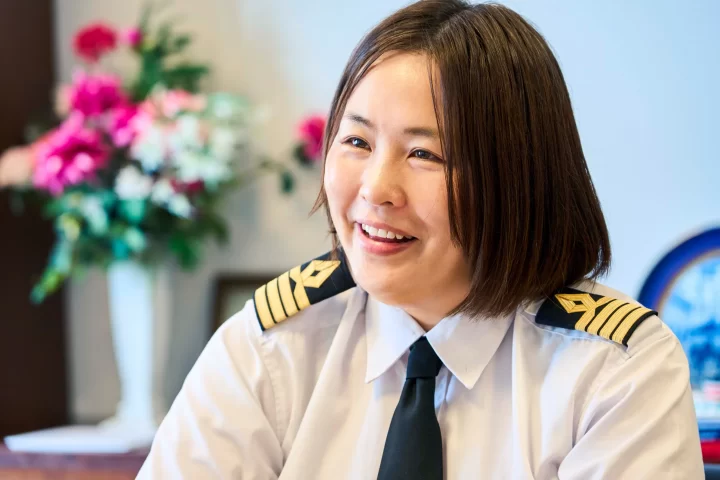
When the interview took place in late August, she had just completed a voyage that lasted approximately six months, ending at the end of July. This time, they traveled mainly through Southeast Asia, crossing the seas between numerous countries aboard a PTCT(Pure Car & Truck Carrier).
"This time, the route was relatively short, going from Japan to places like China, Taiwan, Singapore, and Sri Lanka and then back. It was also a ship for training purposes, so there were about 20 cadets (new employees, trainees) on board."
Her roots lie in the everyday life she had as a child, surrounded by the sea. Born in Matsusaka City, Mie Prefecture, she spent her weekends at the yacht harbor in the neighboring city of Tsu, spending time on her father's yacht. An experience she had in the third grade of elementary school became a major turning point in her viewing the sea as a field of work.
"When I heard that a Japan Maritime Self-Defense Force minesweeper was coming into port in Matsusaka, my family and I decided to go see it, and that's when I first learned that there were jobs that involved working on ships. It was around the time the Japan Maritime Self-Defense Force was deployed to the Persian Gulf after the end of the Gulf War, and I was impressed by the story of a Self-Defense Force officer who had been on board the ship and said that he had been able to contribute to the safety of maritime traffic around the world through mine removal missions. Then one day, the words "Toba National College of Maritime Technology," which is close to my hometown, suddenly caught my eye, and as I researched the school, I became determined to work on ocean-going vessels that transport goods between Japan and overseas while traveling."
After five and a half years at the college, she received a job offer from NYK Line. At the time, there was no precedent for hiring a woman as a navigator, and neither the teachers at the college nor she herself could really grasp the reality of it until the day of the job offer ceremony.
"My teacher at the time advised me to pursue a career as a clerk on a passenger ship. But what I wanted to be was a navigator, so I stubbornly refused to compromise and applied for a position as a navigator on an ocean-going vessel."
After persevering through her initial aspirations, Konishi joined NYK Line. At the time, the world on board ships was completely male-dominated, but both she and those around her were feeling their way through the process, gradually creating an environment where the presence of women was taken for granted. After numerous voyages, Konishi rose through the ranks to become a first officer, and 13 years after joining the company, she finally became the first female captain.
"I loved my job as first officer too. But after becoming captain, I realized after three weeks that I enjoyed it so much that I couldn't go back to my previous job. I think it's because, before, I felt like I was just handling a part of the ship's work, but as captain, I started working with the mindset that it was 'my ship'."
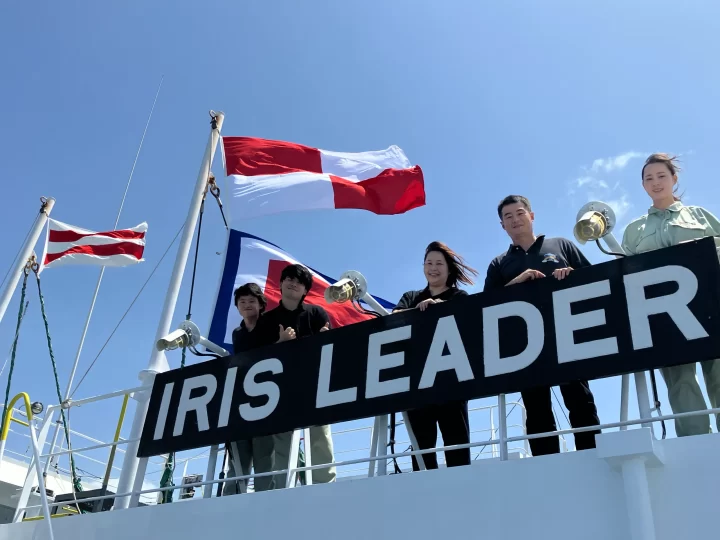
The work environment of ocean-going vessels
They sail across the sea, load and unload cargo at ports, and then head to another port. Sometimes they spend as long as six months without returning to Japan. This "workplace" on an ocean-going vessel is quite different from that on land.
"My colleagues change regularly. Of course, there are people I get along with and people I don't, but no matter what, we only work in the same space for a maximum of six months, so in that sense, it's a good way of working, a senior employee once said."
While on board, colleagues build a relationship of trust, supporting each other's work and living spaces 24 hours a day. However, once disembarked, they don't know when they'll see each other again. Konishi says that while the existence of satellite internet and social media that can be used at sea has brought about some changes, colleagues on ocean-going vessels are still very much like once-in-a-lifetime encounters.
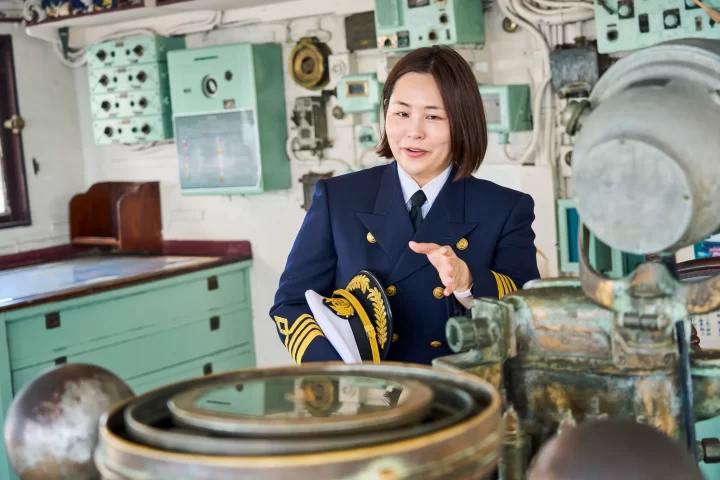
Furthermore, the diversity of backgrounds among my dozens of colleagues has remained unchanged since the beginning.
"At NYK Line, we have seafarers from a diverse range of countries, including the Philippines, Indonesia, India, Romania, and Croatia. Everyone has different motivations for joining a ship. Some are from the Philippines or India, and have family members who work on ships, and they say they want to become captains or chief engineers someday. It's a tough job, but perhaps the appeal lies in being able to use your skills and earn foreign currency."
When building a workplace with colleagues who have different customs and native languages, Konishi has always paid close attention to communication. She believes that the more people see each other's faces and thoughts, the more likely they are to help each other out, even beyond the boundaries of their usual roles, when someone is in trouble. She says that during her time as a navigator, she even tried this to help members from different countries get along.
"During our night shifts, we shared ghost stories with each other. I told a story about a ship's ghost with a ladle, and the Filipino sailor who heard it told me a story about a female monster whose body separated into upper and lower halves, with only the upper half flying away. We scared each other, then laughed, and we became closer after that."
The temporary bond formed between colleagues born and raised on different lands, sharing the same workplace and living space at sea—that's something that can only be created on ocean-going vessels traversing the world's oceans.
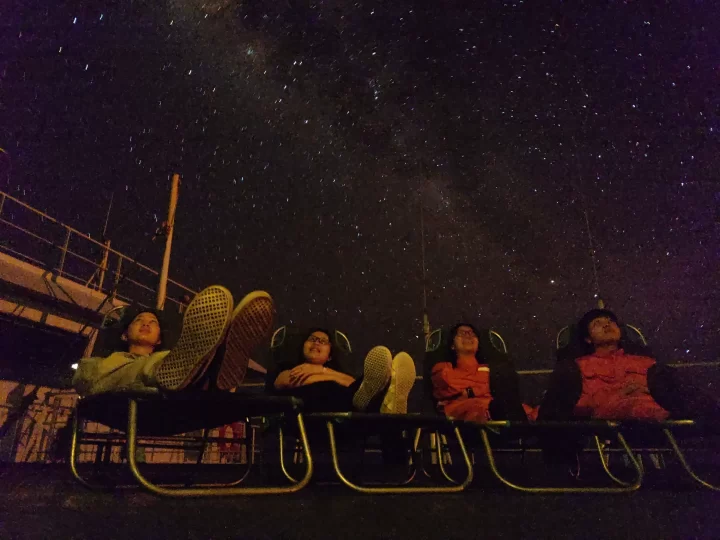
The sea is where it all begins.
Working on an ocean-going vessel means spending the vast majority of your time in a limited space at sea. Naturally, everyone looks forward to their time on land more than anything else. Once the disembarkation schedule is set, colleagues' conversations revolve entirely around "what we'll do during our time off," and how to spend their time ashore at ports of call is also a major point of interest.
"When we docked in Livorno, Italy, we took a taxi from the ship for 15 minutes to the Leaning Tower of Pisa, took some pictures, and then returned to the ship in another 15 minutes. We split into two teams and did this for 30 minutes each during our one-hour shore leave. What's more, the captain at the time took the lead in doing it! We've had many longer shore leaves than that, but that 'highly motivated time' was particularly memorable."
Konishi says that because she has worked in the ocean for many years, her perspective on the sea, which had always been a familiar part of her life, has changed.
"In the past, when you traveled by land and reached the coast, that was a dead end. But after 20 years in this job, the sea has become for me a place where 'it all starts again.' The sea is no longer the end; I've come to feel that if there's a sea, you can go anywhere from there."
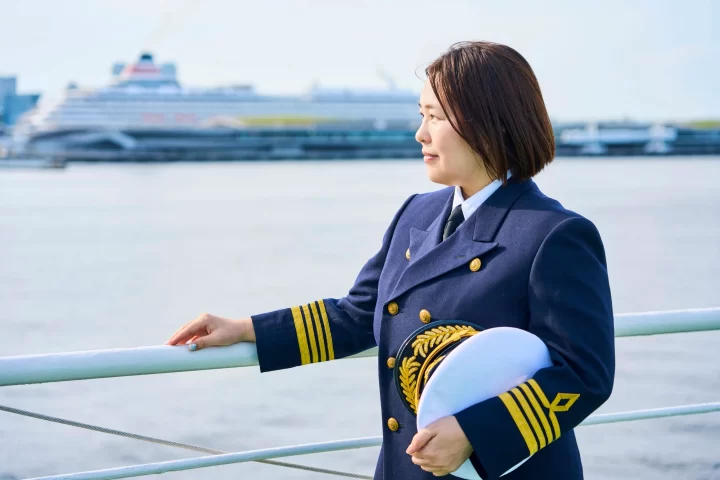
What does the sea mean to me, and to the land? Her feelings and shifts in thinking, gained from maintaining a perspective of viewing the land from the sea while on a ship, are likely to shake up the impression we, who have always viewed the sea from land, have of it.
"Japan is often said to be an isolated island nation, but my perception has changed. I now believe that, rather than being surrounded by the sea, it is actually a place that is open to the whole world."
The captain and crew's next job begins at sea. And that's where the world opens up for them.
The world was supposed to be open, but it's becoming smaller again.
The sea, a place of beginnings, open to the world. However, the modern world, as seen through Konishi's eyes, is in utter chaos.
"In those times, news was readily available, and I spent every day thinking about the responsibility I had for everyone's lives."
Her most recent voyage, which lasted until the end of July, initially had a destination in the Persian Gulf in the Middle East when it set sail in February. However, on February 28, when they were just two or three days away from the Strait of Hormuz, Iran began its naval blockade of the strait.
While some of the cadettes and crew members grew increasingly anxious, she, as the person in charge on board, assessed the situation while waiting for the company's decision. At the same time, she had set a deadline for the final decision she needed to make himself. Fortunately, an agreement to return to the ship was quickly reached with headquarters, and safety was secured for the time being.
"We had a party planned for that time, and despite the situation, we decided to go ahead with it. I told everyone, 'Our company prioritizes safety. I know you're probably worried because you haven't heard anything yet, but everything will be alright,' and they all nodded in agreement. Soon after, I received the news (about her return), so I didn't have to shoulder the responsibility all by myself. My company really helped me out."
Even amidst world-historical events, she remained focused on her duties as captain and creating a positive atmosphere on board. As a result, the voyage continued to Asia without major disruption.
Having observed the world from the sea, she has undoubtedly and acutely grasped the changes in the world since joining the company, not just in this case.
"Having worked in this field for 22 years, I've noticed that the number of safe seas to sail has decreased recently. When I first joined the company, there were no pirates in the Gulf of Aden (a bay in the northwestern Indian Ocean that connects to the Arabian Sea to the east and the Red Sea to the west), and we could even enter the Red Sea (as of August 2026, NYK Line has suspended ship operations to both areas). A little further back, we even called at ports in Lebanon, but places we used to be able to go are no longer accessible. My world expanded through the sea. I used to be able to go anywhere by sea, but now my world has become smaller again. I find this very regrettable."
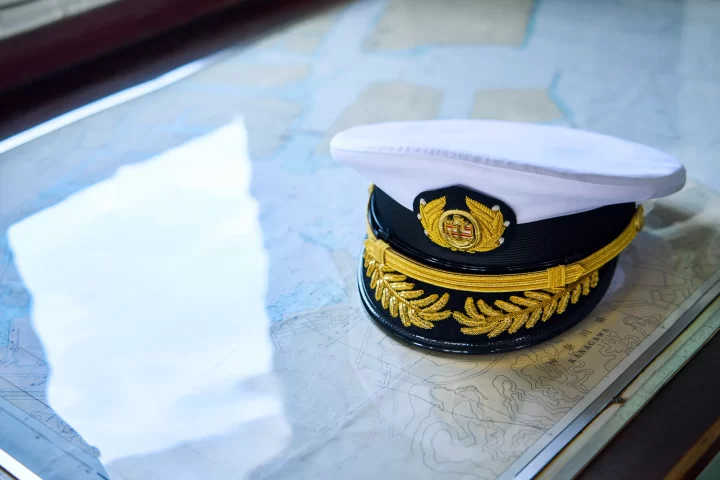
With the global situation changing moment by moment, what are her thoughts on the future of herself and her work as a ship captain?
"At NYK Line, even those in maritime positions regularly work on land. A captain's job at sea has an impact on every aspect of a single vessel. On the other hand, during land-based assignments, decisions can affect hundreds of ships operated by NYK Line. They're completely different scales of work. Now that I understand how valuable both types of work experience are, I feel that both are equally important."
Through travel between land and sea, her world has expanded. And as she fulfills her duties, her world will continue to expand from the sea.
"To be honest, even now, I sometimes feel depressed as the day of boarding approaches. I'm responsible for the lives of the crew, and there's nothing easy about working on a ship, physically or mentally. Yet, everyone, including myself, comes back to the ship and works as if nothing happened. It's strange, but at times like these, I truly feel that I'm glad I'm working as a captain."

Tomoko Konishi
Born in Mie Prefecture in 1983. After graduating from Toba National College of Maritime Technology, she joined NYK Line as a maritime officer. She gained experience as a navigator on ocean-going vessels and in 2017 became the first female captain in NYK Line's history. After a period of land-based work, she is currently back on the water as a captain.
My favorite port is Hamburg, Germany. The port that makes me happy when I visit it is my local port in Ise Bay.
Text/Realization: Daiki Kato (3710Lab)