Listening to "The Future of the Sea" Vol. 2
Sonoko Sato (film director)

While attending university, in my hometown of IshinomakiI filmed two movies.
In 2019, while on leave from the Department of Film at Nihon University College of Art, Sonoko Sato filmed a feature film called "Haru wo Kasanete" in the Okawa district of Ishinomaki City, her hometown. After returning to school, she produced the documentary film "Anata no Hitomi ni Hanaseta" as her graduation project, fulfilling her childhood dream of "making a film in my hometown someday." These two films attracted attention at independent screenings held in more than 30 locations starting in 2021, and were released in theaters nationwide in 2024.
"Haru wo Kasanete" and "Anata no Hitomi ni Hanaseta" are two works that complement each other, like nested boxes, depicting the memories of the Great East Japan Earthquake that struck Sato's hometown and the changes it brought about in people's relationships and their inner selves. Although she herself escaped harm, she lost her younger sister, who was two years younger than her and attended Ishinomaki Municipal Okawa Elementary School, where 74 children and 10 teachers and staff members perished. However, what is most striking is that, rather than the tragedy of the earthquake, the fluctuating emotions of the characters and the subsequent struggles of those left behind are depicted with a fresh and delicate touch in both the drama and documentary versions.
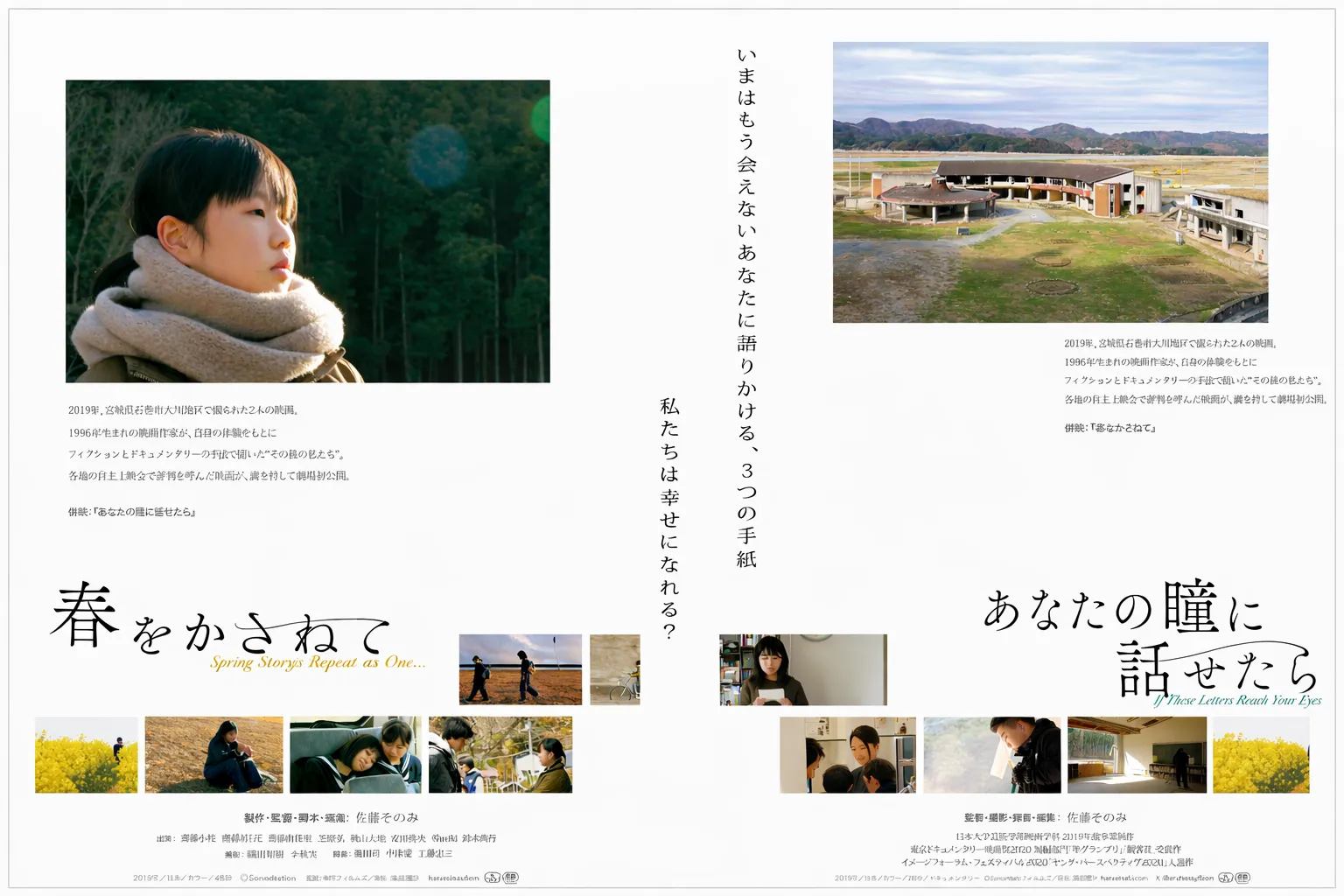
The protagonist of "Haru wo Kasanete," Yumi, is the same age as Sato at the time, 14 years old, and is also depicted as having lost her younger sister in the earthquake. Reporters are constantly coming and going from Yumi's house, and she bravely deals with their interviews.
"I was different from Yumi. Tetsuya Tadano, who appears in 'If I Could Talk to Your Eyes,' answered questions more properly, but I would run away from reporters, evade them, or ask them questions back. Basically, I was asked the same things in every interview, so I felt like I wasn't growing, like time was standing still. After the earthquake, the local summer festival was revived, and as we were all watching the fireworks, I could sense cameras pointed at me from afar. When I looked, sure enough, there were photographers and reporters I knew. Since taking pictures was my hobby, I would point my camera at them in return."
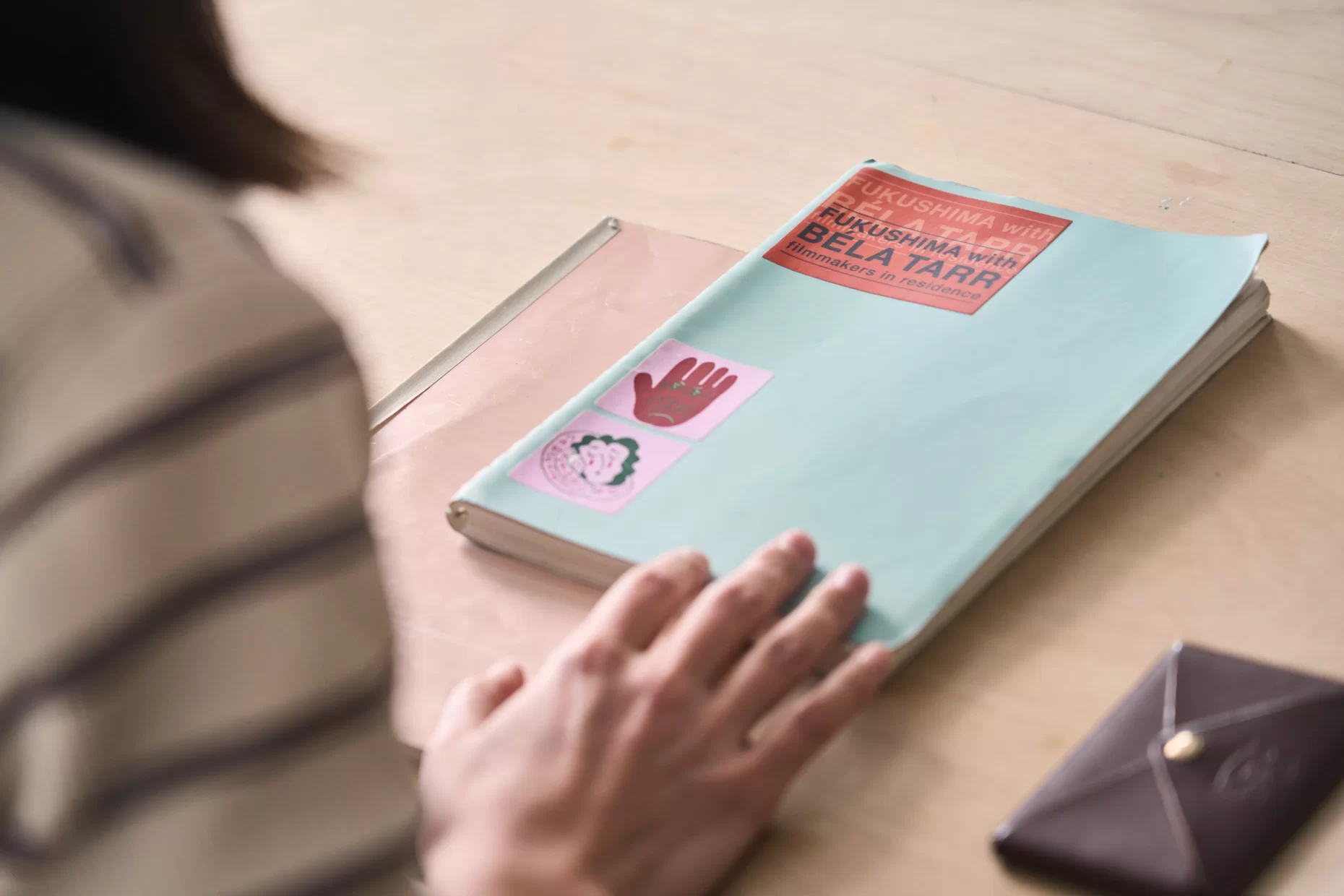
It made me unable to write stories. Facing an overwhelming reality
Sato, who said this, actually had been interviewed before the earthquake.
"There's a literary award called the '12-Year-Olds' Literature Award' hosted by Shogakukan, and in 2009 I won it with my occult horror novel 'The Mushroom Curse,' so a reporter from the Yomiuri Shimbun came to my house to interview me. I met that reporter again when the movie was released, and he told me that he was troubled because I didn't talk much back then (laughs)."
Sato says that, not just with "The Mushroom Curse," she has been writing novels since she was in the upper grades of elementary school and has always dreamed of making films someday. She loved creating stories, but says, "The earthquake, a reality far more overwhelming than any story, came along and I was unable to forget it and create stories. Even after entering university in 2015, I was still bound by it."

"I thought that if I made a film about the earthquake, it would be judged as 'a film made by Sonoko, who lost her sister.' But in the end, no matter what I wrote, the sea and death would come up. It wasn't until my third year of university that I finally realized, 'I can't get out of this unless I write about the earthquake and myself head-on.' So I decided to take a leave of absence and made 'Haru wo Kasanete,' and then made 'Anata no Hitomi ni Hanasete Tara' as my graduation project."
Having finally come to terms with reality after completing two previous works, Sato shot the short film "Sleeping Swan" in 2024 as part of the Agency for Cultural Affairs' commissioned project "ndjc (New Directions in Japanese Cinema): Young Filmmaker Development Project." This film is a heartwarming work about a protagonist in his twenties who struggles with memories of childhood sexual abuse and confronts the events of the past.

Even after the earthquake, "I still love the sea."
Even after the earthquake, Ms. Sato says she still "loves the sea."
"I didn't actually see the tsunami, so I don't have that feeling of not being able to go near the sea. On the contrary, I'm drawn to the sea more and more. I live in Tokyo now, but I often go to Kamakura to see the sea. That's why the large Kitakami River, which flows into the sea, appears in the scene where the main characters have an important conversation in 'Haru wo Kasanete,' and there are also seascapes in 'Anata no Hitomi ni Hanaseta.' That being said, my family home is in the innermost part of the Okawa district, about 9-10km from the mouth of the Kitakami River, so I grew up more in the mountains. I took the bus to elementary school, which was about 4km from the sea. My first experience of the sea was the sea in Shizugawa, Minamisanriku town. Every year, the children's association would camp at a place called Kamiwari Cape Campground, and the next day we would play at Shizugawa Beach. It was fun. I can't swim, though (laughs)."
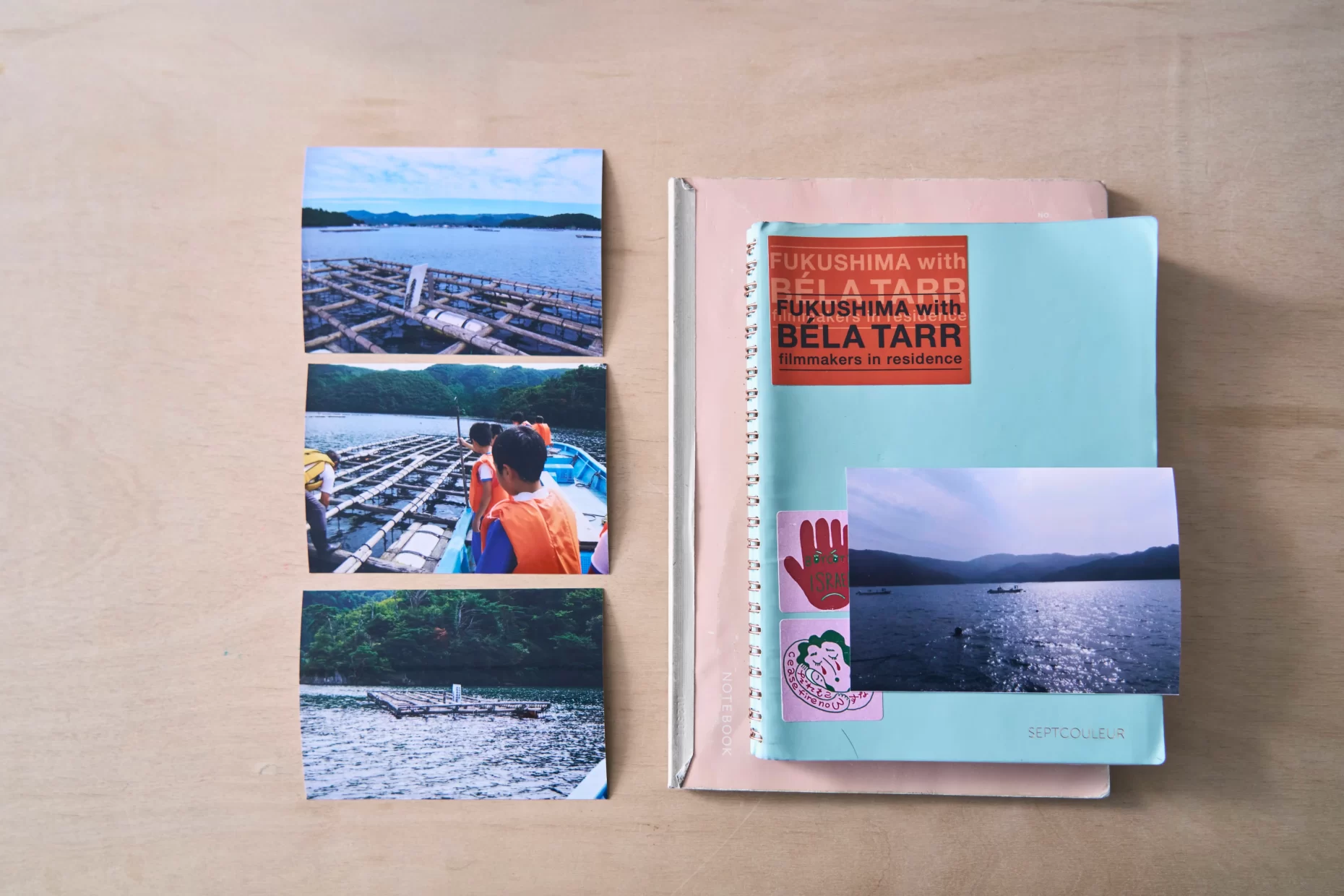
There is one more unforgettable memory of the sea for Mr. Sato.
"Every year, sixth-graders at Okawa Elementary School get to experience oyster farming as part of their curriculum. There's a place called Nagatsuraura near the mouth of the Kitakami River, which is famous for oyster farming, and they had oyster rafts there specifically for Okawa Elementary School. I think we went there in the middle of winter, around February. We all got on a boat and were shown how they worked, and then they grilled oysters for us near the shucking area, and we ate about ten big oysters. It was a luxurious lesson, wasn't it? After the earthquake, there was a time when people said that oyster farming in Nagatsuraura might not work anymore, but it has made a full recovery, and the farms are still operating today. The mothers of my classmates have even created and are selling a new oyster sauce, and they've even won an award for it. The sea took away so many things from us, but it's because of the sea that people like this are coming back to work, and new things are being created."

Things to do to preserve Things that change
One of the filmmakers who influenced Sato is Chris Marker (1921-2012), whose representative work, "Sans Soleil" (1983), is an experimental film that combines footage Marker shot in Japan, Africa (Guinea-Bissau, Cape Verde), Iceland, Paris, and San Francisco with other footage. Whatever Marker's intentions were at the time, when viewed today, it feels like a collection of snapshots of lost landscapes. When asked about the role of such footage, Sato replied, "I always have the feeling that I want to preserve this place because it might disappear someday."
"There are things that can only be captured now, and the lives of the people living there are among them. I have a strong desire to capture those things in film. I think it's wonderful to be able to preserve on video things like the expressions on people's faces and how they were enjoying themselves. 'Haru wo Kasanete' features many local grandparents and people who knew me from the past. Of course, I probably can't film it that way anymore. On the other hand, it's difficult to think about what it means to preserve something as a physical object. When we were discussing whether or not to preserve Okawa Elementary School as a disaster memorial, I felt torn between two feelings: one that 'there is meaning in future generations seeing this school building,' and the other that 'isn't it just something I want to preserve to soothe my own feelings (as an alumnus)?' Even now, someone comes to that place every day as part of disaster prevention education to listen to the storytellers' accounts, and leaves in tears. But those people will forget someday, and I wonder if this is what everyone wanted."

Sato says that what she personally wants to preserve for the future is "the drawstring from my hand-me-down shirt dress that my sister was wearing on the day of the 3/11 earthquake."
"My sister was swept away by the tsunami, but she wasn't dragged out to sea. She was found quickly at the foot of a mountain near her school, along with several other people. We were able to see her four days after the earthquake. She was still wearing all her clothes. I still have those clothes at my parents' house, but this string wasn't swept away by the tsunami. She must have left it at home when she went to school. I found it tied up and brought it with me to Tokyo in a pouch. It's something I want to keep and preserve."
When asked about the "future of the ocean," Ms. Sato replied, "That image is vague in my mind."
"So, I can't talk about that. Instead, it's more of a personal wish, but I'd like to have a house by the sea someday, even if it's not in my hometown. Also, I want to cross the ocean with my work! 'Sleeping Swan' was screened at the Fresh Wave International Short Film Festival in Hong Kong, and 'Spring Over and Over' and 'If I Could Talk to Your Eyes' were screened in Switzerland and South Korea. I thought these stories would only resonate with Japanese people, but people overseas really connected with them, so I want to continue taking my work to various countries."
"I'd like to make a film about the sea someday," says Sato, who is currently planning a new film project. "I don't know if it will come to fruition, but I'd like to film in my hometown again someday. Now that I think about it, the sea doesn't really appear much in 'Haru wo Kasanete' (Layering Spring). I'd like to properly film the sea in my hometown in a feature film someday."

Sato Sonomi
Born in Ishinomaki City, Miyagi Prefecture in 1996, he is a film director. While on leave from the Department of Film at Nihon University College of Art, he produced the feature film "Haru wo Kasanete" (2019), based on his experiences during the Great East Japan Earthquake. His graduation project, the documentary "Anata no Hitomi ni Hanaseta" (2019), won the Runner-up Grand Prix and the Audience Award in the short film category at the Tokyo Documentary Film Festival 2020. In 2024, he produced the short film "Sleeping Swan" as part of the "ndjc: Young Filmmaker Development Project".
News
"Spring Over and Over" "If I Could Talk to Your Eyes"
Screening Information
<Tokyo>
■ At the special exhibition "Speaking about the difficulty of talking about it - 15 years of dialogue surrounding Okawa Elementary School"
Screening date and time:
[1st] March 14, 2026 (Sat) 11:15-12:45
[2nd] March 15, 2026 (Sunday) 11:15-12:45
[3rd] March 22, 2026 (Sunday) 12:00-13:30
Venue: Tokyo Polytechnic University Nakano Campus
Organized by: Tokyo Polytechnic University, Interactive Media Department, "Art & Media Laboratory"
<Click here for details.>
<Ibaraki Prefecture>
■Cineport Theater MITO vol.100 100th ANNIVERSARY SCREENING
Screening date and time: March 7, 2026 (Sat) 16:00~
Venue: Café + zakka + gallery Minerva (2-3-38 Miyamachi, Mito City, Ibaraki Prefecture, Hotel Mito Silver Inn 2F)
Organized by: 310+1 Cinema Project
<Click here for details.>
Miyagi Prefecture
■Night BOOKs vol.1 night cinema
Date and time: March 8, 2026 (Sunday) Doors open from 17:00 / Screening from 19:30
Venue: 8BOOKs SENDAI (1-15-25 Hachihonmatsu, Taihaku-ku, Sendai City, Miyagi Prefecture / Approximately 10 minutes on foot from Nagamachi Subway Station)
Reservation: Not required (entry and exit permitted at any time)
Organizer: 8BOOKs SENDAI
■Film Forum "the blue print"”
Screening date and time:
March 7, 2026 (Sat) 16:00 - "If I Could Talk to Your Eyes"
March 8, 2026 (Sunday) 10:00 AM - "Spring Layers"
Venue: Theater Kinematica (1-3-12 Chuo, Ishinomaki City, Miyagi Prefecture)
Organized by: Theater Kinematica / Ishinomaki Theatre Arts Association
<Click here for details.>