"The sea is vast, so big..." The skills and wisdom (= folk tools) nurtured through the long relationship between the sea and people, for obtaining its bounty, and the hopes (= toys) that people have held for a bountiful catch towards the sea.Musashino Art University Museum & Library, Folklore Materials RoomExcavated from the approximately 90,000 folk artifacts held by the institution. Separate exhibition rooms are provided for folk tools and toys, and a series of articles, with commentary by Professor Koji Kato of the university, explores the deep connection between people and the sea that has continued from ancient times to the present.Click here for project details.). The seventh installment will introduce traditional sea tools with the theme of "fishing with baskets and traps."
A fish trap from which you cannot escape once you enter.
Bamboo cages used to catch prey in the sea or rivers are collectively called "uke." Depending on the region, they have various names such as "mondori," "do," "dou," "moji," and "ue." "Mondori" is a corrupted form of "modori," referring to the "kaeshi" or "modori" (return) attachment at the entrance of the bamboo cage, which prevents anything that enters from escaping.
Fish traps are set in places where fish, shrimp, crabs, and other aquatic life are likely to be found or where they might swim, luring them in. This fishing method is called "trap fishing" because it involves luring the fish into a trap. Therefore, the most important thing is to set the traps so that the fish do not realize they are traps, requiring wisdom to match the rhythm of the tides and water currents, and the skill to blend them into the surrounding environment.
Once you've set the trap, all you can do is wait. You won't know if it's successful or not until you pull the trap out of the water. Because traps that use cages to catch fish are deeply connected to the ecology of the prey, it can be said that it is a world of masterful skill where a keen eye for observing nature and experience are essential.
Sea fish trap
The traps used in the sea include cylindrical bamboo cages for catching conger eels, for example. These traps are attached to a rope at regular intervals, like a longline, and then submerged in the sea. On the Sendai Bay side of the Oshika Peninsula in Miyagi Prefecture, there are traditional bamboo cage traps for catching conger eels, which are similarly connected in large numbers and submerged in the sea. Nowadays, plastic traps are more common. On the other hand, there are also bell-shaped cage traps for catching filefish, bigfin reef squid, cuttlefish, and other similar fish.
While traps that use the power of the sea, such as slow currents, to lure in prey do have their days of failure, the underlying principle is not to catch everything in one go, but to accept only what the sea offers.
Deep-sea fish traps
Fishing for Japanese spider crabs, which inhabit the deep sea, involves various methods, including bottom trawling (trawling) where nets are dragged from boats, bottom gillnetting where crabs are caught by getting entangled in nets, and cage fishing, where cages filled with bait are lowered to the seabed to lure and trap the crabs. In the deep sea at depths of 200 to 400 meters, such as off Inubosaki in Chiba Prefecture, the Pacific coast of southern Kyushu, and Suruga Bay, crab cages with bag-shaped nets are set to lure and capture the Japanese spider crabs that live inside. This can also be considered a type of cage fishing, as bait is placed inside to lure the crabs in and once inside they cannot get out.
Freshwater fish trap
River traps come in various types, catching fish such as ayu and dace, as well as mitten crabs. They are all placed in fish migration routes or in areas with relatively calm currents, and the fish are lured in by the bait placed inside. Traps range from those that can be carried by hand to those that are more like equipment that a person can place directly into. Traps were also used in rice paddies and waterways to target eels and loaches.
Lake Biwa in Shiga Prefecture has a distinctive round, cylindrical trap called a "tatsube." These traps are used to catch freshwater shrimp and fish such as carp and crucian carp that come to spawn in the reeds and aquatic plants along the lakeshore. Hundreds of them are strung together on a rope, creating a longline-like structure. Nowadays, identical plastic versions of these traps are used.
Folk Art Gallery
Bullet-shaped fish trap
The trap used to catch river fish has a narrow opening at the back, so that if the fish swims forward, it will fall into the cage. The gentle curve of the bullet shape is also a design feature that reduces resistance to the water flow. The body of the trap is made by weaving together bamboo strips of the same thickness in a regular pattern, like a bamboo blind.
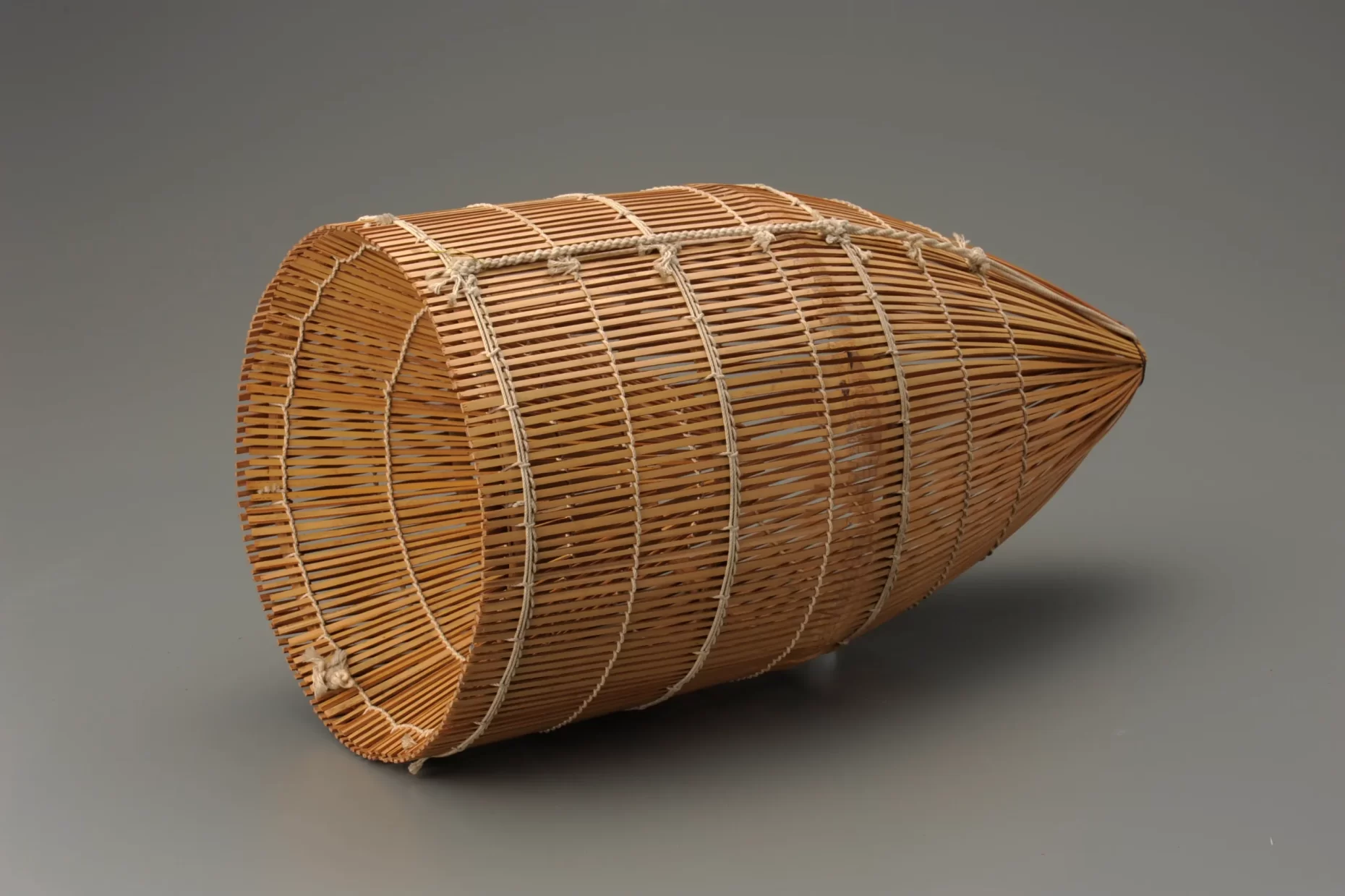
Integrated fish trap
The trap, which is shaped like a bullet, is not made by creating and attaching a separate "return" part, but rather by continuously weaving the "return" from the body of the trap. This trap is used to catch loaches, and the exit is covered with cloth and tied with string to prevent escape.

A house-shaped fish trap?
高知県には、まるで竹籠の家のような形の筌が見られます。これは底と蓋は木製で、魚籠(びく)のような形の竹籠の底に入り口があります。入り口には斜めに竹ひごが並んでいるなどして、中に入った魚は出ることができません。非常に存在感のある筌ですが、名人は、獲物が部屋に入ったことすら気づかないうちに捕獲してしまうような仕掛け方を工夫するのです。

Long and slender fish trap
Eel traps used in rice paddies and waterways were designed to be as undetectable as possible, by submerging them in the mud of the paddy field to remove the oil from the bamboo. They have triangular "barbs" at both ends. Some eel traps are made by weaving bamboo into a cylindrical shape, while others are made from whole bamboo with the nodes removed and the outer skin shaved off.

Cylindrical fish trap
The cylindrical bamboo traps are used to catch conger eels and moray eels in the sea. Taking advantage of their habit of lying in wait in crevices in rocky areas to catch prey, the bamboo traps are made to look like hiding places to lure them in. This practice is common in the southern Kii Peninsula, Minamiboso, and Kochi Prefecture, and the sight of moray eels being filleted and sun-dried is a winter tradition.

Planning, supervision, and writing
Koji Kato
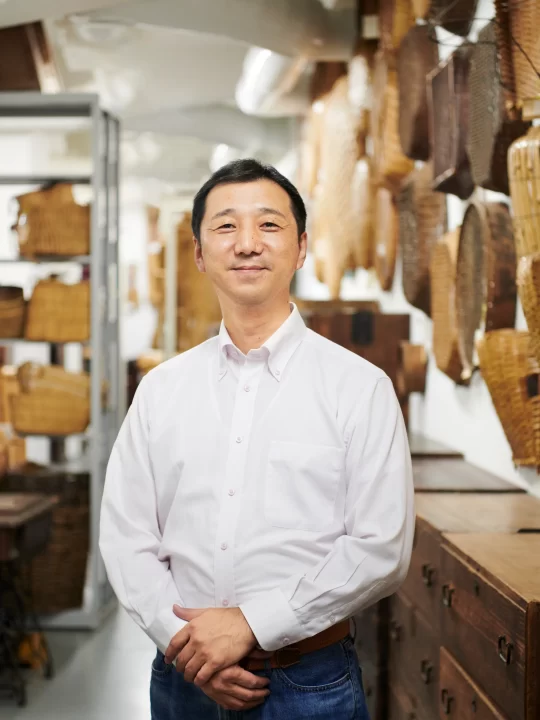
Professor at Musashino Art University, specializing in folklore (research on folk implements). Holds a PhD in Literature. Previously served as a curator at the Wakayama Prefectural Kii Fudoki-no-Oka Museum and a professor at Tohoku Gakuin University (concurrently serving as a curator at the university museum), before assuming his current position in 2019. His major publications include "Folklore: Facing and Expressing the Past" (Musashino Art Publishing Bureau/2022) and "Folklore: Public Studies: Learning and Practicing for Oneself" (Musashino Art Publishing Bureau/2025).