"Shiosai RADIO" is a playlist curated by musicians and DJs, featuring songs related to the ocean.
Volume 7 features the DJ unit "GQOMZILLA," consisting of DJ MORO and KΣITO. Gqom, the genre of dance music that forms the core of their sets, originated in Durban, a port city in South Africa. The two are among the few DJs and producers in Japan who have performed at festivals and events across the African continent and have firsthand knowledge of the local scene. They are also members of the five-person DJ crew "TYO GQOM," which includes mitokon, K8, and HW BINGO. They have provided a selection that is perfect as an "introduction to Gqom," enjoyable even for beginners who are unfamiliar with the genre.
What is "Gqom," which originated in the port city of Durban?
—I hear DJ MORO is from Yokohama.
DJ MORO Yokohama, despite being known for its sea, is centered around its harbor rather than sandy beaches. I remember fishing from the piers and wharves in the past. With its beautiful night views and seagulls flying overhead, Yokohama has a certain romance to it. Where I live now is a little distance from the harbor, but I make it a point to stay close to Yokohama. I lived in Tokyo for a while, but I've come back.
—KΣITO-san is from an inland area of Tokyo and doesn't have much connection to the sea, but I heard that you have been to Durban, a port city in South Africa.
KΣITO I got to experience the real scene. I made music in a studio with a local producer, went to multiple parties, ate Shisanyama (South African barbecue), went to the beach... Also, Durban faces the Indian Ocean and has historically been strongly influenced by Indian culture, so I ate the local specialty, Bunny Chow, which is curry served in a hollowed-out loaf of bread. Gqom is said to have originated in Durban's "townships" (black residential areas established on the outskirts of cities as part of the former apartheid policy), but of the several townships, the one I visited was in a suburban area a little further inland from the coast, on a hill.
—First of all, what kind of music is Gqom?
KΣITO To put it very simply, Gqom is a particularly fast and powerful form of house music that originated in South Africa. It features a straightforward four-on-the-floor beat. (*1) There are very few songs with a typical BPM; their music is characterized by unconventional rhythm patterns, and while there are some songs with a more soaring vocal style, I think there are more songs that focus on the call-and-response and the beat. It seems to have gained global recognition from the mid-2010s onwards. (※2) In that sense, I get the impression that there are many Gqom chips with a value around 125.
DJ MORO As a precursor to Gqom, in the 1990s in South Africa, there was a music genre called "Kwaito," which was like a slower version of house music. It combined elements of R&B, hip-hop, and house music that were hits in the West with chants and percussion in the local Zulu language. I think Gqom may have emerged as a kind of sudden mutation, evolving from this genre.
*1 Four-on-the-floor: A rhythmic style commonly found in house and techno music, where the kick drum is played in quarter notes.
*2 BPM: Beats Per Minute. A unit indicating the tempo per minute.
—So, "house music," which originated in Chicago, USA, is the key, right? I can also sense the influence of a port city where foreign cultures are mixed in.
KΣITO South Africa is one of the few countries in the world where house music is so well-established. Because dancing is a common part of the culture, Gqom, like house music, is characterized by many long, danceable tracks that are 5-6 minutes long. Even within the African continent, for example, current Nigerian Afrobeats often features impactful tracks that are only 2-3 minutes long.
Okay, so let's take a look at the video for the first track on the playlist, DJ LAG's "WaWaWa".
DJ MORO This is Gqom's latest song.
Everyone is dancing with great energy and graceful steps.
KΣITO Music is a very familiar part of life for people in South Africa. Events and parties are held not only in clubs, but also in pubs and restaurants, with the music playing at high volume. The venue I went to in the suburbs of Durban was outdoors, with houses visible right there, but they were playing music at an incredible volume. Also, as you can see in this video, there are these vans called "taxi"...
—A red van, similar to a Toyota Hiace, came out.
KΣITO It's like a shared bus, and they're blasting music as background music here too.
—This "WaWaWa" is a good example, but Gqom's approach is more like "sharing the ride," wouldn't you say? It feels like they frequently engage in fluid collaborations, including with producers and singers.
KΣITO In South Africa, I think it's more common for producers to work together, gathering at home or in a studio, to create music, rather than one person working alone.
DJ MORO Speaking of the songs I've chosen, the third track, Busiswa's "uWrongo," features veteran producer Rudeboyz. The sixth track, DJ TIRA's "Ngawe," features vocals by Dladla Mshunqisi and Joocy producer BlaQRhythm.
—It seems that artists from Gqom, including DJ TIRA, have a strong tradition of supporting up-and-coming artists by starting their own labels and production companies after achieving success themselves, right?
KΣITO : Gqom certainly has a vibe of hooking up (elevating) new talent, and there isn't much of an impression that successful people try to "hog the spotlight." There are no barriers between successful and unsuccessful people. It's not uncommon for unknown newcomers to be featured in the works of famous artists. There are many people making music, new producers are constantly emerging, and I feel that the speed at which people become successful is very fast. Looking at Instagram, you can see that some people's clothing has become noticeably neater...
—So it sold well. As a port city, DJ MORO, who is from Yokohama, do you feel any common ground with the "shared ride" culture of Gqom?
DJ MORO In Yokohama, too, the culture of collaborative production by trackmakers and DJs seems to be well-established. The people at the label "PPP (PAN PACIFIC PLAYA)," which I respect, have also released compilation albums and split singles. (※3) They've released numerous works, including [this one], and in the past, LUVRAW & BTB's live performances had a kind of family-like atmosphere, with Mr. Melody (DJ/producer) participating and HueHueBOY (DJ) acting as MC.
*3 Split single: A single record or CD containing songs by two or three different artists.
"Taxi Kick" was born in a shared van.
On the other hand, Gqom's major work is also known to include DJ LAG and Busiswa's collaboration with Beyoncé on the song "MY POWER."
KΣITO Should I have added it to the playlist?
DJ MORO : It's probably the most famous Gqom in the world. However, so many DJs have played it on the dance floor, and for us it's become too much of a staple... Considering the underground nature of Gqom, we decided not to include it in this playlist.
KΣITO Around 2017-2019, when Gqom was gaining attention and popularity internationally, both Beyoncé and Major Lazer released tracks incorporating Gqom. The movie "Black Panther," set in a fictional Africa, was released around the same time, and interest in African music, including its soundtrack, was on the rise. However, around that time, the focus of the trend shifted from Gqom to Amapiano. Amapiano, with its lower BPM and further hybridization, became even more widely listened to and popularized around the world than Gqom.
DJ MORO There was a time when Amapiano was at the height of its popularity, and Gqom wasn't releasing as many new tracks as before. I imagine Gqom DJs had a tough time during that period, finding new music to play was difficult.
KΣITO Nevertheless, Gqom has established itself and continues to be listened to, and it seems to be making a comeback recently. It also seems like they've been releasing a lot of interesting new music.
—I hear there's also a hard-rock style of Gqom called "Uthayela," which means "wavy iron plate" in Zulu.
KΣITO Gqom has many subgenres, including "Dombolo," which is named after a round African bread. There's also "Taxi Kick," a fierce and dark genre that was created during a party in the minivan "taxi" that I mentioned earlier.
DJ MORO It was distorted, and the sound quality was bad.
KΣITO "Taxi Kick" isn't widely available on subscription services, and the platforms where you can purchase it aren't very well-established. Some of its works are only circulating through group messages on the WhatsApp app.
—Is Gqom also releasing music on vinyl?
DJ MORO While there have been releases from British and European labels, including "Gqom Oh!", I'm not aware of any large-scale pressings by local African labels other than Uganda's "Nyege Nyege Tapes." And Durban clubs didn't even have turntables, right?
KΣITO There are all sorts of clubs, but from what I've seen, they basically don't have turntables, only CDJs (CD players for DJs). Gqom's distribution is mainly digital, and I think there's a lot more of it available on Apple Music and Spotify compared to other genres.
—You created this playlist from those songs. What was the direction you took when selecting them?
DJ MORO I tried to select tracks that would give listeners an understanding of what Gqom is if they listened to the whole album. The first six tracks are the latest Gqom, starting with easy-to-listen-to vocal tracks. The latter half is more of a derivative of Gqom, gradually deviating from it. Razzler Man's "Sound Bwoy" also incorporates elements of Amapiano. State OFFF and ABE are Dutch artists, and audiot909, who is the producer of the last track, is a Japanese producer who creates Amapiano.
KΣITO Track 14, "Insimbi," is Gqom with elements of Afro Tech (a blend of techno, house, African-derived rhythms, and futuristic, sci-fi-esque elements). House is the core, branching out into various genres, then coming together again, creating a chemical reaction that results in something different. South African music is still evolving in real time.
—Finally, a message to our listeners.
KΣITO Gqom is simply music you can dance to. You can find tons of videos of people dancing to it on YouTube, Instagram, and TikTok, so I hope you'll enjoy those as well. We ourselves learned a lot from mitokon (DJ and writer, a member of TYO GQOM), who knows South Africa very well, so it feels a bit presumptuous of us to speak about Gqom as if we represent the scene, but we thought we'd share our thoughts anyway.
Thank you so much for today!
TRACKLIST
DJ LAG & Djknator – WaWaWa (feat. Thobeka)
QUE DJ – We Don't Play the Same Glom (feat. General C'Mamane)
Busiswa – uWrongo (feat. Rudeboyz)
Unticipated Soundz – Skibha SaBravo
Dj Pepe x KwaH[NSG], Dladla Mshunqisi, Beast Rsa & Konke – Party Island (Remix)
DJ Tira – Ngawe (feat. Joocy, Dladla Mshunqisi & BlaQRhythm)
DJ Lag & Okzharp – Steam One
Raido – Eco-Tek
xiangyu – Poo Pad Pong Curry (Emo Kid Remix)
AkiidMusiq & Djknator – Durban Drift
WRACK – South Bird
Razzler Man – Sound Bwoy
ABE – DRMGN
Deep Narratives, ZVRI, Culoe De Song – Insimbi
State OFFF – Awakening
audiot909 – Ibuki (Gqom) [feat. KΣITO]
Profile
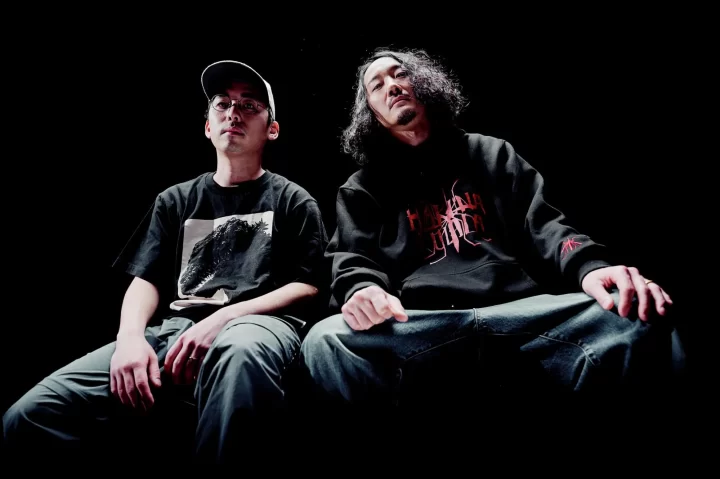
GQOMZILLA | Gomujira
A DJ unit consisting of DJ MORO and KΣITO, who also work together as TYO GQOM and Technowolf, and who primarily play Gqom music.
Gqom was formed to express a more powerful sound by combining DJ MORO's emotional DJ style with KΣITO's finger drumming.
In 2020, he released the mix CD "Okusha" through Black Smoker Records.
Interview and text by Hanazawa Ou
Illustration by Oki Masahide